
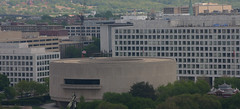
Hirshorn Gallery of Art : 無料・フリー素材/写真
Hirshorn Gallery of Art / dbking
| ライセンス | クリエイティブ・コモンズ 表示 2.1 |
|---|---|
| 説明 | Hirshorn Gallery and Hirshorn Sculpture GardenLate 1930sThe US Congress mandates a Smithsonian art museum for the National Mall; a design by Eliel Saarinen is unveiled in 1939. New York financier Joseph H. Hirshhorn (born Latvia, 1899) pursues a lifelong passion for collecting art.1940sWorld War II and shifting priorities shelve the museum project. On the National Mall in Washington, DC, the only venue for visual art is the National Gallery of Art, which focuses on old masters. In the late 1940s, Joseph Hirshhorn, now in his 40s and enjoying phenomenal success from uranium mining investments, begins recrafting his collection from "classic" French Impressionism to works by living artists, American modernism of the early 20th century, and sculpture.1950sIn 1955, Joseph Hirshhorn sells his uranium interests for more than $50 million. His collection expands (late 1950s-early '60s) to warehouses, an apartment in New York, and an estate in Greenwich, Connecticut, with extensive acreage for sculpture. 1960sA 1962 sculpture show at New York's Guggenheim Museum awakens an international art community to the breadth of Hirshhorn's holdings. Word of his collection of modern and contemporary paintings also circulates, and institutions in Italy, Israel, Canada, California, and New York vie for the collection. President Lyndon B. Johnson and Smithsonian Secretary S. Dillon Ripley make a successful pitch for a new museum on Washington, DC's National Mall. An Act of Congress establishes the Hirshhorn Museum and Sculpture Garden, Smithsonian Institution (1966). The museum is primarily federally funded, although Hirshhorn later contributes $1 million toward building construction. Joseph and his fourth wife, Olga Zatorsky Hirshhorn, visit the White House. Groundbreaking takes place in 1969.Early 1970sFounding director Abram Lerner (born 1913) oversees research, conservation, and installation of over 6,000 objects, brought from the Hirshhorns' Connecticut estate and other properties to Washington, DC. The museum building and garden complex, designed by Gordon Bunshaft (1909-1990) of Skidmore, Owings & Merrill, nears completion on the National Mall. Ambassador Daniel Patrick Moynihan chairs the Hirshhorn's first Board of Trustees. The New York Times: "... a fortress of a building that works as a museum." Joseph Hirshhorn speaks at the inauguration (1974), saying: "It is an honor to have given my art collection to the people of the United States as a small repayment for what this nation has done for me and others like me who arrived here as immigrants. What I accomplished in the United States I could not have accomplished anywhere else in the world." One million visitors see the 850-work inaugural show in the first six months. ARCHITECTUREDesign ConceptBunshaft conceived the Hirshhorn as "a large piece of functional sculpture" among the shrinelike structures of the National Mall. The hollow-centered, elevated cylinder-primarily a gallery for paintings-floats above nearly four acres of landscaped grounds for sculpture. Curved galleries expand the visitor's view of works. Window-walls open the interior and focus on the fountain, while a recessed garden provides serenity. Like the round Guggenheim Museum in New York, the drum-shaped Hirshhorn is bold compared with its neighbors (Mall constructions tend to be brick Victorian fantasies, modernist block buildings, or neoclassical temples), but symmetry and frontality conserve the official Washington, DC, architectural mode. The plaza was redesigned in 1991 to create six "rooms" of inviting, verdant space for the display of a selection of large-scale contemporary sculptures in the Hirshhorn collection. The building's four piers serve as sheltered coves for more intimately sized works. The fountain holds fascination for young and old alike as the central water jet shoots up almost four stories. Special events such as concerts and workshops often take place between the piers, under the "drum" of the building, and on the granite-paved plaza.The Hirshorn is the only building on the National Mall named for an individual.SitingThe Hirshhorn is sited exactly halfway between the Washington Monument and the US Capitol, anchoring the southernmost end of the so-called L'Enfant axis (perpendicular to the Mall's green carpet). The National Archives/National Gallery of Art Sculpture Garden across the Mall, and the National Portrait Gallery/Smithsonian American Art building several blocks to the north, also mark this pivotal axis, a key element of both the 1791 city plan by Pierre L'Enfant and the 1901 MacMillan Plan. Technical Information •Building and walls surfaced with precast concrete aggregate of "Swenson" pink granite •Building is 231 feet in diameter; interior court, 115 feet; fountain, 60 feet •Building is 82 feet high, elevated 14 feet on four massive, sculptural piers •60,000 square feet of exhibition space on three floors •197,000 square feet of total exhibition space, indoors and outdoors •274-seat auditorium (lower level) •2.7 acres around and under the museum building •1.3-acre sculpture garden across Jefferson Drive sunken 6-14 feet below street level, ramped for accessibility •Second- and third-floor galleries have 15-foot-high walls, with exposed 3-foot-deep coffered ceilings •Lower level includes exhibition space, storage, workshops, offices •Fourth floor includes offices, storage Architectural Timeline1969. The Hirshhorn Museum groundbreaking takes place on the former site of the Army Medical Museum (built 1887) after that brick structure is demolished. A controversy soon develops over naming a building on the historic National Mall after a living person, as well as the new federal museum's modern look and intrusively expansive sculptural grounds. 1971.Amid this climate of controversy, Bunshaft's original conception for the Sculpture Garden-an elongated, sunken rectangle crossing the Mall with a large reflecting pool-is abandoned. He prepares a new design based on an idea outlined by art critic Benjamin Forgey in a Washington Star article. The new adaptation shifts the garden's Mall orientation from perpendicular to parallel and reduces its size from 2 acres to 1.3 acres. The design is deliberately stark, using gravel surfaces and minimal plantings to visually emphasize the works of art. 1974. The museum opens with three floors of painting galleries, a fountain plaza for sculpture, and the Sculpture Garden. In preparation for the opening, Hirshhorn curators and staff spend several months scrupulously planning the locations of artworks, both indoors and outdoors. Lightweight foam-core "dummy" sculptures are used to resolve the final placement of works in the garden. The originals, many of which had been airlifted from Hirshhorn's Connecticut estate onto flatbed trucks for transport, are put into place in the weeks before the opening. 1981. Closed since the summer of 1979, the Sculpture Garden reopens in September after a renovation and redesign by Lester Collins, a well-known landscape architect and founder of the Innesfree Foundation. The design introduces plantings, paved surfaces, accessibility ramps, and areas of lawn.1985.The Museum Shop is moved to the lobby, increasing exhibition space at its former location on the lower level. 1993.Closed since December 1991, the Hirshhorn Plaza reopens after a renovation and redesign by landscape architect James Urban. The 2.7-acre area around and under the building is repaved in two tones of gray granite, and raised areas of grass and trees are added to the east and west. THE FOUNDING DONOR The Hirshhorn Museum's founding donor, Joseph H. Hirshhorn (1899-1981), immigrated to New York from Latvia when he was 4 years old. His widowed mother settled with her 13 children (Joseph was the twelfth) in the Williamsburg section of Brooklyn. In time, Hirshhorn would become a financier, philanthropist, and well-known collector of modern art whose gift to the Nation of 6,000 paintings, sculptures, drawings, and mixed-media pieces established his namesake museum on the National Mall. It has been open to the public since 1974.At the age of 13, Joseph left school to become a newsboy. Two years later he took his first salaried job, on Wall Street in Manhattan, earning $12 per week. At 16, he launched his career as a financier by using his savings of $255 to become a stockbroker. When he was 18, Hirshhorn acquired his first works of art: two etchings by the 16th-century German artist Albrecht Dürer, purchased for $75 each. This acquisition marked the beginning of a lifelong passion for collecting art, assisted by an innate talent for making money. In the late 1940s, Hirshhorn's mining investments in uranium-rich Canadian land cemented his status as a wealthy man. Hirshhorn eventually turned his attention to the art of contemporary masters. He became an avid collector of works by living painters such as Arshile Gorky, Stuart Davis, Edward Hopper, Milton Avery, Raphael Soyer, and Larry Rivers. He socialized and visited with many of these artists and assisted them when he could-helping his friend Willem de Kooning, for example, finance the construction of a Long Island studio in exchange for works of art. As a collector, Hirshhorn also went after works by American painters of the late 19th and early 20th centuries. Thomas Eakins, Louis Eilshemius, Ashcan School artists, and first-wave modernists in touch with European developments are prime examples. Hirshhorn was a frequent and welcome visitor in the studios of those whose works he collected, and many of these visits were commemorated in photographs. One such occasion was a 1966 visit to Pablo Picasso at Mas Notre Dame de Vie, near Mougins, in the south of France. Bearded photographer Edward Steichen was a guest of the Hirshhorns at their house : Villa Lou Miradou, in Cap d'Antibes. Ultimately, Hirshhorn was perhaps best known as a collector of 19th- and 20th-century sculpture. He acquired major works by pioneers such as Auguste Rodin and Constantin Brancusi, as well as innovative contemporaries including Alexander Calder, Henry Moore, and Alberto Giacometti. Developing fast friendships, Hirshhorn showed his enthusiasm in numerous ways: by visiting Moore's studio, for instance, and enjoying the art scene with Giacometti.The breadth of Hirshhorn's sculpture collection was unknown to the general public until 1962, when selected works were loaned to the Guggenheim Museum in New York for a major exhibition. Several international museums and governments courted Hirshhorn, but his comprehensive modern art holdings ultimately went to the Smithsonian Institution. Lady Bird Johnson, wife of then-President Lyndon B. Johnson, played a supporting role by paying personal visits to Joseph and his wife, Olga. After an Act of Congress established the Hirshhorn Museum in 1966, the Johnsons joined the Hirshhorns for the museum's groundbreaking in January 1969, just prior to the inauguration of President Richard M. Nixon. Among the numerous honors afforded this self-made philanthropist during his lifetime was, appropriately, the Horatio Alger Award in 1976. The award is designed to honor determination, perseverance, and success in the face of adversity. Dividing his time between Washington, DC, and Naples, Florida, Joseph Hirshhorn remained a vigorous art collector and patron until his death in 1981. His subsequent bequest to the museum nearly doubled the size of the collection. Building on this nucleus of Hirshhorn artworks, curators keep current on new art while refining the collection, which today numbers some 11,500 pieces. A constant stream of new acquisitions, including curators' purchases and gifts of art from many donors, extends the Hirshhorn legacy of passion for new art.The Hirshhorn Sculpture GardenLocated on the National Mall halfway between the Washington Monument and the US Capitol, the Sculpture Garden provides a contemplative haven for viewing over 60 works of art. These large-scale sculptures date from the 1880s to the 1960s and explore the same stylistic progression of ideas and styles as the small and mid-sized works in the Hirshhorn interior galleries. The works exemplify a wide range of styles, including traditional figures by artists such as Auguste Rodin and Aristide Maillol, biomorphic abstraction by artists such as Henry Moore and Barbara Hepworth, and boldly abstract and kinetic compositions by artists such as Alexander Calder and Mark di Suvero. |
| 撮影日 | 2005-05-03 15:15:25 |
| 撮影者 | dbking , Washington, DC |
| 撮影地 | |
| カメラ | Canon EOS DIGITAL REBEL , Canon |
| 露出 | 0.004 sec (1/250) |
| 開放F値 | f/7.1 |
| 焦点距離 | 135 mm |