
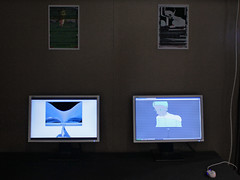
Jon Satrom - QTzrk (2011) http://Jonsatrom.com/ & Videogramo - olympic Games (2010) http://www.videogramo.8bitpeoples.com : 無料・フリー素材/写真
Jon Satrom - QTzrk (2011) http://Jonsatrom.com/ & Videogramo - olympic Games (2010) http://www.videogramo.8bitpeoples.com / Rosa Menkman
| ライセンス | クリエイティブ・コモンズ 表示 2.1 |
|---|---|
| 説明 | Jon Satrom performs realtime audio/video, spends time data-bending, makes kludgey work-flows, creates colorful glitch-ware, and enjoys working within collaborative projects and open systems. He spends his days fixing things, making things work, and teaching. He spends his evenings breaking things, learning, and searching for the unique blips inherent to the systems he explores and exploits. When creating glitch-art, developing kludgy workflows is key. Softwares and languages with loop-holes, open-ports, and forgotten-functions are integral to constructing situations for glitching. In my mind, no other program embodied this ethic more than QuickTime. It’s popularity, and the fact that it’s development was to position itself within a multimedia paradigm yet-to-be solidified, makes QuickTime (versions 1.5 – 7.6) a quagmire of failures. The rewrite of QuickTime as QuickTime X has broken an environment that helped form my ideas of how malleable digital video can be. The drumbeat of “progress” has stripped esoteric codecs and functions in favor of current flavor of standardized media consumption. Popular computer program releases are similar to code-volcanoes barfing new functions on-top of themselves creating mountains of functionality. Due to the fact that QuickTime was one of the first popular desktop video playback and editing technologies, the program is full of strange utopic abandonware. Aside from the myriad of codecs available, two of my favorite QuickTime features are QTVR and the ability to skin one’s own player. These are once celebrated features are now forgotten on the volcanic crater of QuickTime 7. I’ve been working and performing with these techniques for years and have only found it necessary to articulate my love and investment as I find my go-to-tool on the chopping-block of our upgrade-culture. For now, I can rest assured: it’s a weird-chopping-block; there’s still time. For now, QuickTime7 has been transformed from a player into a utility. Even now (OSX 10.6.6), there are elements of QuickTime X that rely on the robust functionality of QuickTime 7.When working against an upgrade culture and hesitant to celebrate a retro-ness within my own work, I’m forced to jump the shark and exploit my favorite functions before they are ”legacy features”… ”QTzrk” is powered by QuickTime 7 on MacOS and Windows Videogramo:I am looking at all your websites, and I am completely confused by all your alter egos! Francoise Gamma on the computers club and Item Videogramo on 8bitpeoples; Who is Videogramo and who is Gamma? ComputersClub asked me to be part of the club, but with a name. I didn't want to use my real name, so I invented Francoise (which is derived from my real name) and Gamma from color correction. I think of Francoise Gamma as a fatal rebirth of Videogramo.Some of your newer work like "the head on the piano" on Vimeo has become less textured and more 3d, is that new and something you are going to do more?If I would use the textures and patterns like I used in Videogramo ...I would need a whole enterprise to do animation+patterns... Videogramo's working method is crazy… madness, frame by frame ... hhgg, (although sometimes also semi automatic ^__^). Gamma is more and more wirelined, it is an evolution or involution of Videogramo. More "new", less patterns and more animations (more and more) = ) and mutated movies. In Gamma there are almost no corrupted bodies. I think in this alter ego my mind is changing through other … corruptions.How is failure or glitch part of your work?I work with glitch in textures and erratic models (sometimes pure glitch from conversion of 3D formats). I also reference errors through the impossible positions of the models. In Gamma the error plays a role in motion overall. I would maybe call this "glitch simulation" or emulationCorruption plays a formal role (errors in exporting 3d images), but this "fatal rebirth" of the image also plays a role on a conceptual and narrative level. I think there is not one logics to explain my fascination with error… I think that perhaps I recognize reflexion of myself in the error, or of the universe in general. |
| 撮影日 | 2011-02-28 17:52:55 |
| 撮影者 | Rosa Menkman , amsterdam, Netherlands |
| タグ | |
| 撮影地 | |
| カメラ | Canon EOS 550D , Canon |
| 露出 | 0.04 sec (1/25) |
| 開放F値 | f/4.5 |
| 焦点距離 | 24 mm |