
Common Crow : 無料・フリー素材/写真
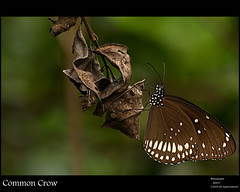
Common Crow / Ajith (അജിത്ത്)
| ライセンス | クリエイティブ・コモンズ 表示-改変禁止 2.1 |
|---|---|
| 説明 | The Common Crow (Euploea core) is a common butterfly found in South Asia. In India it is also sometimes referred to as the Common Indian Crow, and in Australia as the Australian Crow. It belongs to the Crows and Tigers subfamily of the Nymphalidae (Brushfooted butterflies).The Common Crow is the most common representative of its genus Euploea . Like the Tigers (Danaus spp), the Crows are inedible and thus mimicked by other Indian butterflies.Description-----------------------The Common Crow (Euploea core) is a glossy black butterfly with brown underside with white marks along the outer margins of the wing. The wingspan is about 8-9 cm and the body also has prominent white spots.Range------------------It is found in Sri Lanka, India, Myanmar and Australia.Status----------------Very commonHabitat----------------It is found everywhere in India right up into the mountains till 8000 feet. Occasionally it swarms in the low, wet, jungles of South India due to the abundance of its foodplants which are spread over three orders of plants.Habits----------------The butterfly, being protected by its inedibility, has a leisurely flight. It is often seen flying about shrubs and bushes in search of its host plants. It visits a large variety of flowering plant species.On hot days large numbers of these butterflies can be seen mud-puddling on wet sand. This butterfly also gathers on damaged parts of plants such as Crotalaria, Heliotropium to forage for chemicals precursors to produce pheromones.Along with other Danaids such as the Tigers, the Common Crow is one of the most common migrating butterfly speciesProtection-----------------------The Common Crow is distasteful due to chemicals extracted from the latex of the food plants consumed in their caterpillar stage. Thus protected, they fly in a leisurely manner, gliding skillfully with wings held slightly above the horizontal. This indicates its protection due to inedibility to a predator. The inexperienced predator will try attacking it, but will learn soon enough to avoid this butterfly as the alkaloids in its body cause vomiting.The butterfly has tough, leathery wings. When attacked it shams death and oozes liquid which causes any predators to release them. The butterfly thus has the ability to recover 'miraculously' after the predator thinks it has been killed.This is spotted from Chamakkav , Payyanur, Kerala ,India.[Explored] |
| 撮影日 | 2008-11-06 10:47:42 |
| 撮影者 | Ajith (അജിത്ത്) , Bangalore, India |
| タグ | |
| 撮影地 | Payyannur, Kerala, India 地図 |
| カメラ | NIKON D40X , NIKON CORPORATION |
| 露出 | 0.013 sec (1/80) |
| 開放F値 | f/5.6 |
| 焦点距離 | 300 mm |