Columnar-jointed rhyolite (Palisade Rhyolite, North Shore Volcanic Group, Mesoproterozoic, 1096-1097 Ma; Palisade Head, northeastern Minnesota, USA) 1 : 無料・フリー素材/写真
Columnar-jointed rhyolite (Palisade Rhyolite, North Shore Volcanic Group, Mesoproterozoic, 1096-1097 Ma; Palisade Head, northeastern Minnesota, USA) 1 / James St. John

| ライセンス | クリエイティブ・コモンズ 表示 2.1 |
|---|---|
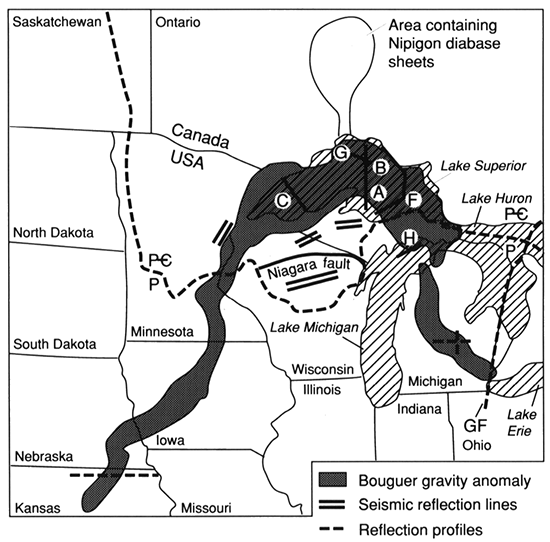
| 説明 | Columnar-jointed rhyolite in the Precambrian of Minnesota, USA.Along the northern shore of western Lake Superior are numerous exposures of a lava flow-dominated succession called the North Shore Volcanic Series. This is equivalent to & the same age as the Portage Lake Volcanic Series of northern Michigan's Keweenaw Peninsula (www.flickr.com/photos/jsjgeology/albums/72157632266738191). The North Shore and Portage Lake successions are ~1.1 billion years old and represent basalt lava flows, plus minor sedimentary rocks, that filled up an ancient rift valley. This old rift is the Lake Superior segment of the Mid-Continent Rift System, a tear in the ancient North American paleocontinent of Laurentia (see: www.kgs.ku.edu/Publications/Bulletins/237/Woelk1/gifs/fig...). Tectonic rifting started along this tear, exactly like the modern-day East African Rift Valley. Laurentia's Mid-Continent Rift System started and then stopped and was subsequently filled and buried. This ancient failed rift is now exposed on either side of Lake Superior in North America's Great Lakes.The outcrop seen here is a lakeshore cliff consisting of ~pinkish-colored, columnar-jointed rhyolites. Rhyolite is a felsic, aphanitic, extrusive igneous rock. It is a minor lithology in the North Shore Volcanic Group, which is mostly basalts. This unit is the Palisade Rhyolite (also known as the Palisade Head Rhyolite), which is 90 to 100 meters thick. The rocks are finely crystalline with small phenocrysts of quartz, K-feldspar, altered ferromagnesian silicates, magnetite, and zircon (Green et al., 2011).The Palisade Rhyolite has traditionally been interpreted as a lava flow, but features present in the lowermost and uppermost portions of the unit indicate that it is a rhyolitic rheoignimbrite (see Green, 1989 and Green et al., 2011). Ignimbrite deposits form by explosive volcanic eruptions that generate much fine-grained to coarse-grained debris that flowed across the surrounding landscape (= pyroclastic flow). Rheoignimbrites have experienced post-depositional flow of material that has deformed internal layering.Stratigraphy: Palisade Rhyolite (a.k.a. Palisade Head Rhyolite), Upper Southwest Sequence, North Shore Volcanic Series, Keweenawan Supergroup, upper Mesoproterozoic, 1096-1097 MaLocality: Palisade Head, lakeshore headland between the towns of Silver Bay & Ilgen City, northern shore of western Lake Superior, northeastern Minnesota, USA (47° 19’ 12.05” North latitude, 91° 12’ 38.37” West longitude)----------------------Some references on Palisade Rhyolite geology:Green (1989) - Large rhyolites of the Keweenawan North Shore Volcanic Group. in Field trip guidebook. Institute on Lake Superior Geology, Proceedings 35(2): A1-A15.Miller et al. (2001) - Geologic map of the Duluth Complex and related rocks, northeastern Minnesota. Minnesota Geological Survey Miscellaneous Map Series Map M-119.Green et al. (2011) - The North Shore Volcanic Group: Mesoproterozoic plateau volcanic rocks of the Midcontinent Rift System. The Geological Society of America Field Guide 24: 121-146. |
| 撮影日 | 2015-06-09 11:21:19 |
| 撮影者 | James St. John |
| タグ | |
| 撮影地 |