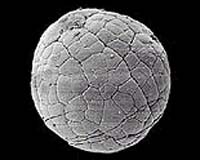
Embryos and Ancestors : 無料・フリー素材/写真
Embryos and Ancestors / James St. John

| ライセンス | クリエイティブ・コモンズ 表示 2.1 |
|---|---|
| 説明 | These are my personal notes taken during a geology presentation at: "Evolving Form and Function, Fossils and Development", a Symposium Honoring Adolf Seilacher for his Contributions to Paleontology, and Celebrating his 80th Birthday, which was held at Yale University in New Haven, Connecticut, USA in 2005. I give the notes here because they may be of some interest. Do not expect them to always be in complete sentences, etc.-----------------------------------Embryos and AncestorsPresented by: Phil Donoghue (School of Earth Sciences, University of Bristol, Bristol, Britain) (www.bris.ac.uk/earthsciences/people/philip-c-donoghue/ind...)1 April 2005----------The fossil record is traditionally perceived to be biased against embryological remains. Since the Zhang & Pratt embryo paper, several finds have been made in various places, especially in the Doushantuo Formation of South China - has produced animal & plant/algae embryos. A growth series of fossil embryos is now available. Parapandorina (jpaleontol.geoscienceworld.org/content/74/5/767/F8.large.jpg) - it has a well known embryological series. No later stages, unfortunately, for the most part (but see Megaclonophycus). The Doushantuo Formation is packed with embryos. Tianzhushania/Megasphaera (senior synonym) - Megasphaera (2.bp.blogspot.com/_J-oN8KCzVDw/SmjEU_30lOI/AAAAAAAAACA/bM...) was originally considered an acritarch (schaechter.asmblog.org/schaechter/images/2008/02/06/acrit...). It is a resting cyst/cleaving embryo with an inside envelope. It's identification is unclear - is it a pteropod? The South China fossil embryos occur in cherts & phosphorites.The Dengying Formation is Ediacaran in age, but earliest Cambrian dolostones have fossil embryos, too.The Dengying Formation overlies the Doushantuo Formation in the Yangtze Platform. The Dengying has cleaving embryos present. Olivooides (www.spacedaily.com/images/life-first-animal-bg.jpg) - this fossil has been identified as a series of cleaving embryos. Described by Stefan Bengtson. Compare Olivooides with the loricae of some modern organisms. It possibly has cnidarian/conulariid affinities. Pseudooides - Steiner has recently well defined an embryological series. Has a well-defined pinched germ band (lobopodan/onychophoran). Some later stages of something lobopod-like - but related to Pseudooides? Michael Steiner has found an embryo with a membrane and Onychodictyon-like sclerites poking through. (www.esacademic.com/pictures/eswiki/79/Onychodictyon.jpg) Markuelia has been pinned down, phylogenetically. (cdn.physorg.com/newman/gfx/news/hires/2006/Fig_02Markueli...) It is now identified as a metazoan embryo by Stefan Bengtson. Markuelia was a direct developer. Its head is poorly preserved in Stefan’s sample, though. The body has surface annulations - it's metameric. Stefan suggested a lobopod affinity or an annelid affinity. Simon Conway Morris suggested that Markuelia may be a halkieriid. Halkieriids include the last common ancestor of molluscs, annelids, brachiopods. But, these three groups are primitively indirect developers. Dong Xiping has dissolved lots of rock - now has lots of new Markuelia samples (Markuelia hunanensis from Middle Cambrian of China). Some have their heads preserved. The Markuelia head has a terminal donut mouth & three circlets of radially arrayed spines. ~30 mm long, ~130 segments. This information allows us to reject the lobopod hypothesis - lobopods have a subterminal mouth. This information also allows us to reject the annelid hypothesis and halkieriid hypothesis (these were ideas based on fossils associated with Markuelia).New hypothesis - Markuelia has affinities with the Introverta (= nematodes, priapulids, nematomorphs, kinorhynchs, loriciferans). Markuelia appears to be a sister group to the Kinorhyncha, Loricifera, Priapulida clade (KLP). This is cool information, but Markuelia is a direct developer, while KLP are all indirect developers. This means that the KLP (= Scalidophora) common ancestor was a direct developer. So, embryos do have phylogenetic relevance. But, we need more data/samples to prevent fossil embryos from being curiosities. Late Neoproterozoic & Cambrian - shouldn’t there be a lot of indirect developing embryos? Is this apparent bias toward the presence of direct developing fossil embryos due to them having higher preservation potential? Someone should do taphonomic experiments with modern embryos to find this out.There's only one planktotrophic larva fossil known (an indirect developer). We can squeeze more out of the data we have already.It’s only been 10-11 years since the first embryos were found and identified.But, dissolution of rock & microfossil fishing have gone on for a long time, for biostratigraphic purposes. So, we're not sure if we have more potential. The Aldan River basin in Siberia has 5 sites with paleoembryos. Northern Australia has 4 sites with paleoembryos. The Lower Ordovician of Nevada has 2 sites with paleoembryos. These are all Markuelia - it disappears after the Lower Ordovician.-------------------Dolf Seilacher questions/comments: What about this embryo taphonomic window? Is it the same taphonomic window as for other exceptionally preserved fossils? Note the stranded jellyfish taphonomic window (Wisconsin, Spain, India) - they only occur in Cambrian beaches - there are lots of them.------------------- |
| 撮影日 | 2015-09-06 03:09:29 |
| 撮影者 | James St. John |
| 撮影地 |