A Neoproterozoic Snowjob: Testing the Limits of the Snowball Earth Hypothesis : 無料・フリー素材/写真
A Neoproterozoic Snowjob: Testing the Limits of the Snowball Earth Hypothesis / James St. John

| ライセンス | クリエイティブ・コモンズ 表示 2.1 |
|---|---|
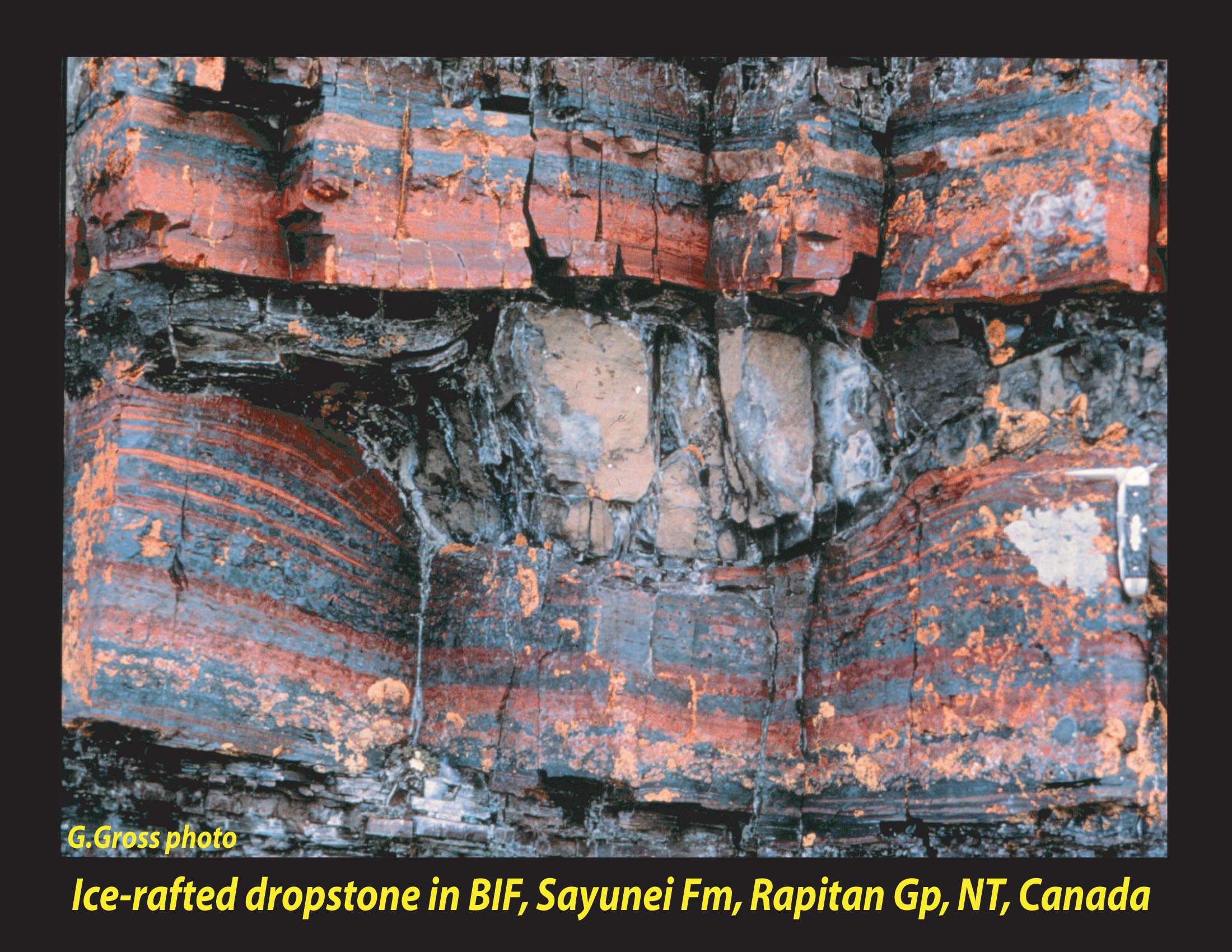
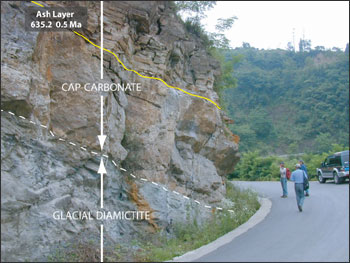
| 説明 | These are my personal notes taken during a geology presentation. I give them here because they may be of some interest. Do not expect them to always be in complete sentences, etc.-----------------------------------A Neoproterozoic Snowjob: Testing the Limits of the Snowball Earth HypothesisPresented by: Nicholas Christie-Blick (Columbia University, New York, New York, USA) (www.ldeo.columbia.edu/~ncb/)25 April 2002----------Paul Hoffman’s Snowball Earth Hypothesis doesn’t work very well. (www.flickr.com/photos/jsjgeology/20900468815)A classic locality for seeing Neoproterozoic tillite is in northern Namibia.The most severe Ice Ages ever on Earth appear to be the Marinoan Ice Age (= Varanger Ice Age) at ~600 million years ago & the Sturtian Ice Age at ~750-700 million years ago.Showed a photograph of a large dropstone deforming iron formation. (www.snowballearth.org/slides/Ch3-5.jpg)Evidence for a cold climate at sea level ~600 million years ago: striated pavements, paleo-permafrost (sandstone frost wedges), adjacent to tidal bundles in sandstone.The Elatina Formation in the central Flinders Ranges, South Australia has the best evidence for low-latitude glaciation at sea level - paleomag. shows this locality was at 7.5˚ North latitude (results are close to a primary position). Can see lots of magnetic reversals in the Neoproterozoic glacial interval of the Elatina Formation. This area really made the case for low-latitude glaciation. The typical cap carbonate facies - occurs above Snowball Earth glacial sediments. (www.snowballearth.org/images/dating2.jpg) The cap carbonates are peculiar. In the late Precambrian, can see carbonates above the glacial interval. The cap carbonate sediments (deep water and a continuous interval) are event beds - turbidites (they have sole marks and flute casts) of finely-laminated, homogeneous dolomicrite. They directly overlie glacial rocks everywhere. They are present even in terrigenous sections. Most sections have a few meters only of cap carbonates, though Paul Hoffman focuses on the few sections that have 100s of meters of cap carbonates.See Kennedy, Christie-Blick, & Prave (2001).Low isotopic values in cap carbonates are perceived to be peculiar.-5.5 to -6 δ13C (PDB) is the mantle carbon isotopic value. The modern world has C(organic) at about -28.5 and C(inorganic carbonate) of 0. We see mantle carbon values in Neoproterozoic cap carbonates - this implies zero C(organic) burial. This conclusion is the source of the proposed completely ice-covered oceans in Snowball Earth Hypothesis of Hoffman. δ13C curves go crazy during the Neoproterozoic, compared with pre-Neoproterozoic and the post-Neoproterozoic. Snowball 101: the basic ideas of the Snowball Earth Hypothesis.1) Freezing phase - the entire ocean surface is frozen (even in the tropics) from a runaway albedo feedback. When sea ice reaches 30˚ latitude, the rest rapidly freezes over. Then, primary productivity in the oceans ceases, which accounts for mantle carbon values in cap carbonates. Then, atmospheric carbon dioxide gas (CO2) increases to ~120,000 ppm [parts per million] due to the shutdown of hydrologic cycle and the shutdown of silicate weathering (both are sinks for CO2). The increasing CO2 is coming from the mantle because there was continued volcanism from continuing plate tectonic processes. 2) Melting phase - catastrophic melting phase from the greenhouse effect, on a scale of hundreds of years - very rapid and very warm. This renews silicate weathering, resulting in a drawdown of atmospheric CO2, which delivers alkalinity and base cations to the ocean. The cap carbonates record the transfer of excess atmospheric CO2 to the ocean. The trend of decreasing carbon isotope depletion upward in cap carbonates is due to: 1) protracted shutdown of marine autotrophic activity; 2) high fractional burial of carbonate carbon; and 3) Rayleigh distillation. This is the freeze-fry cycle of the Snowball Earth Hypothesis (see Hoffman, 2000). This freeze-fry cycle is on the order of 10 million years. This model is advocated by Paul Hoffman and others because it plausibly explains many paradoxes in the record. How does one test the Snowball Earth Hypothesis?Global climate model simulations - the catastrophic freeze over starting at 30˚ latitude is actually the result of an artifact in a previous climate model.Look at carbon isotopes in synglacial carbonates (looking at non-eroded carbonates only, though).Sr isotopic information - a measure of weathering influx.Implications to evolution - what are the evolutionary responses and what about bottlenecks?Continental locations - equatorially-located continents are “surprised” in the SEH model - the ice creeps toward them from the poles, then reaching 30˚ latitude, and quickly covers the remainder of the planet. Are the continents really all equatorially-located, though, at the required times? Well, lots of modeling is going on now - each has different purposes, and it is difficult to compare them all. But, can you freeze over the whole ocean at all in climate models? Maybe, but it is very hard to do. The answer is "Not a chance", according to many people.Models start off with CO2 at 315 ppm (corresponding with pre-industrial levels). In the Marinoan world, many continents are at low latitudes, including Australia. The models can’t get an ice sheet remotely close to Australia. What about changing solar luminosity? In the Neoproterozoic, sunlight intensity was less than now, estimated to ~94% of modern intensity. This value is based on astrophysicists’ estimates of a 30% fainter Sun at 4.5 billion years ago, and scaled forward to the late Neoproterozoic. No astrophysicist has yet argued for changes in the rate of solar luminosity increase. So, change the models to 94% of modern luminosity. Still can’t get ice at low latitude Australia in the Neoproterozoic. Add a lower CO2 value of 40 ppm to the model, can get oceanic ice sheets close to the tropics, but still don’t have an all frozen ocean - not close. Look at synglacial carbonates - we now have data about this from four continents. Looked at marine cements, peloids, and oolites (all are in-situ carbonates deposited during the glacial interval). The values are scattered, but typically they are positive, +2 or +3, not -5 as the Snowball Earth Hypothesis says (these are supposed to be close to mantle carbon values, because all of Earth is frozen over, and the only carbon input is from the mantle, through plate tectonic-driven volcanism).Strontium (Sr) ratios are ~invariant throughout the glacial to post-glacial interval. There is no evidence from Sr data for a thousand-fold variation in weathering rates, as expected in Hoffman’s Snowball Earth Hypothesis. The maximum weathering rate for an atmosphere with 120,000 ppm of CO2 is less than 50 times that of the present weathering rate.Secondary hypotheses have been proposed to circumvent the Sr problem. They assert a substantially longer time scale, and they call upon weathering of carbonates, instead of weathering silicates. There are difficulties with these ideas. The longer timescale argument is inconsistent with high fractional burial of carbonate carbon, plus the cap carbonates likely represent ~1000 years years, plus carbonate weathering cannot draw down CO2. Silicate weathering can, but carbonate weathering can’t. So, the cap carbonates are not a product of CO2 drawdown, which is a key Hoffman idea. Carbonate weathering drives cap carbonate δ13C values into a positive upward trend. The Pleistocene glacial maximum had sea level at 120 meters lower than now. 73 meters worth of sea level are trapped in glacial ice on Greenland and Antarctica.Australian glacial facies and magnetic reversals indicate a glacial retreat over a time scale of 100,000 to 1 million years (= much longer than Hoffman’s SEH says).Glacial-eustatic rise continued after glacial-isostatic rebound at low latitudes (the cap carbonates are late glacial, deposited when there was still ice somewhere on Earth).Australia has a 30 meter thick cap carbonates section (they are event beds - turbidites). Alternative Hypotheses for the Origin of Cap Carbonates1) Post-glacial upwelling (Kaufman et al., 1991). But, it is difficult to stratify a glacial ocean, and upwelling of nutrient-rich water leads to enhanced productivity. 2) Gas Hydrate Hypothesis - accounts for the source of light carbon seen in cap carbonates. Gas hydrates are ice that have methane in the lattice. They are common in continental shelves - buried frozen permafrost. Cap carbonates represent destabilization of permafrost methane hydrates during post-glacial flooding of continental margins and interior basins. The temperature increased, and methane was delivered into the water column. Need to have a methane source from a reservoir in shallower areas (a permafrost reservoir, for example). Deeper marine reservoirs of methane aren’t suitable sources for this because a sea level rise will increase pressure and will stabilize the deep ocean methane reservoirs. Is there evidence for the gas hydrate hypothesis? Widespread features in cap carbonates (CC) are consistent with cold seep facies. Can see bedding expansion and cementation in deformed beds below the cap carbonates in Australia. Can see sheet cracks in cap carbonates - cement was growing into empty spaces. Can see tubes in cap carbonates - gas escape tubes? They are real tubes - can see sediment falling into them. Roll-up structures in sub-photic zone biohermal communities are present in cap carbonates. Can see barite and aragonite fans in cap carbonates - these are cold seep facies features. So, the gas hydrate hypothesis calls upon a pulse addition of light carbon from permafrost methane, followed by steady state recovery. Cap carbonates represent ~10,000 years (rapid accumulation). Mass balance calculations show the plausibility of the gas hydrate hypothesis, using modern ocean constraints. Carbon introduced by methane release can account for a -5‰ shift - need about 3 x 10 to the 17th power moles of methane (CH4). How much carbon is buried in cap carbonates? It's estimated to be 8 x 10 to the 17th power moles of CaCO3. That's the same order of magnitude. How big were the ice sheets in the Neoproterozoic? There is good evidence in Utah - incised paleovalley systems are present in a series of sections - rivers cut into marine sediments (~160 meters of cutting) - they are the same age as the glacial interval. Apparent sea level change of 193 meters for the Pleistocene Ice Age (120 meters + 73 meters) - that is equivalent to a eustatic change of 130 m (need to multiply 193 m by a factor of 1.4 - this accounts for difference of sea level change values seen from islands, which experience water loading with sea level rise, compared with sea level changes that will be seen on the continents). How many Neoproterozoic ice ages? All sections show only two. Multiple events or not? The multiple events idea seems to be based on miscorrelation of the two ice ages, especially in southern to northern Namibia. There were two main events, apparently. One is at 600 million years ago, and one is at ~750 million years ago. All workers agree that they were the most severe ice ages in history. There weren't more than two events. Paul Hoffman's Snowball Earth Hypothesis is not consistent with C and Sr data together, or with eucaryotic evolution (some call on a soft snowball, versus Hoffman’s hard snowball, or a slushball hypothesis), or with the scale of ice-volume changes, or with the duration of glacial retreat (it was on a time scale greater than 100,000 years, not 100 years). The gas hydrate hypothesis is consistent with climate models, outcrop evidence (including strange features in cap carbonates that have been unexplained for a long time), isotopic data, and biological evidence. Permafrost and associated hydrates should have been unusually widespread, because lots of glaciation occurred in the Neoproterozoic (which is an accepted idea by all researchers). The upwelling hypothesis doesn’t work. Snowball Earth Hypothesis doesn’t work. Any other hypotheses out there? They are welcome. Call any of these ideas “Snowball Earth” if you want - the name doesn’t matter.The methane was coming from marine sedimentary basins.There was lots of Precambrian organic carbon, including Precambrian oils and C(organic) isotopic values that hover around zero back to the Archean.--------------- |
| 撮影日 | 2015-09-07 13:42:36 |
| 撮影者 | James St. John |
| タグ | |
| 撮影地 |