
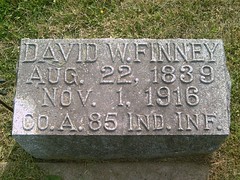
David W. Finney : 無料・フリー素材/写真
David W. Finney / jajacks62
| ライセンス | クリエイティブ・コモンズ 表示-改変禁止 2.1 |
|---|---|
| 説明 | Co. A, 85th IND. InfantryThe Neosho Falls Post, Thursday, Nov. 9, 1916, Pg 1 Funeral of D. W. Finney The body of D. W. Finney was brought from Emporia last Friday to Neosho Falls for interment in the Cedarvale cemetery. Funeral services were held at the home on Saturday, conducted by Rev. Rice of Emporia, assisted by Rev. F. M. Taylor of Neosho Falls. Friends from far and near were present to take part in the last sad rites and to offer sympathy to the bereaved relatives. The services at the graveyard closed with the beautiful and impressive ceremony of the Grand Army of the Republic. The following relatives and friends were here to attend the funeral of D. W. Finney last Saturday, Mr. and Mrs. J. Hemmings of Marceline, Mo., B. S. McConnell and daughter, of Larned, Mrs. Edwin Tucker, Mr. and Mrs. Albert Tucker, H. D. Tucker and Geo. Wood of Eureka, Mrs. A. B. Harris of Kansas City, W. W. Smith and daughter and Mrs. B. H. King of LeRoy. ______ D. W. Finney How typical of all that is the best in Kansas was the life of D. W. Finney which ended this morning in sleep at the home of his son, Warren W. Finney in Emporia. An Indiana soldier in the Civil war, with a gallant record; a pioneer Kansan in Woodson county, serving his neighbors in the sixties in the legislature; this district in the seventies in the senate, specializing on educational matters and temperance; then a lieutenant governor in the eighties, signing the first bill that made Kansas a prohibition state—that was his public record. What a host of strong young men of his kind came into Kansas in those days—Ingalls, Plumb, Martin, Moonlight, Blair, Horton, Simpson, Wilder and Murdocks—the roll extends wide and long. They had ideals; they were public spirited enough to give themselves freely for their ideals, and they builded wiser than they knew. They made possible the Kansas we enjoy today. And foremost among the builders of the sixties, seventies and eighties was Governor Finney—the friend and co-worker of all who were striving for the big fundamental things. How strong and beautiful his life has been, how directly and forcefully he has gone to his goal, and how high and worthy was his aim! It is to men like him who have kept the faith, who believed mightily in good things and worked effectively for what they believed in, that Kansas owes much more of her luster among the stars than she owes to us who reap where we have not sown. He died in the faith, but he had the glorious and unusual blessing of having received the promises not merely to have seen them afar off. So his last days were serene and untroubled. Time justified his faith. Emporia Gazett. _____ Biography of D. W. Finney The following biography of D. W. Finney was written by him a few years before his death and presented to his grandson as a Christmas remembrance. It is here reproduced thinking it may be of interest to the readers of the Post. David W. Finney, third son of Robert and Malinda Finney was born August 22nd 1839 near Anapolis, Pearle county, Indiana. His early life was spent of the farm in what was then the frontier, and from the time he was old enough to work his principal occupation was clearing land, making rails and cutting saw logs for lumber to improve the farm. His schooling consisted of a few months attendance each year at the district school, was a student of Bloomingdale Academy till the war, and the death of his father made other duties imperative. He enlisted as a private in the Union Army in July, 1862 and was mustered in on Sept. 2, 1862 at Terra Haute, Ind. and assigned to Co. A, 88th Indiana Volunteer Infantry; served the first winter in Kentucky in repelling the rebel invasion. In the spring of 1863 was transferred to Tennessee and took part in clearing the country of rebels from Nashville to Franklin. On March 2nd was a part of the command under Col. Coburn in the hard fought battle of Thompson’s Station, Tenn., where a part of the brigade fought all day against the combined forces of Van Dorn, Forrest and Wheeler, and were forced to surrender about 4 o’clock p. m., their ammunition being entirely exhausted. He was taken to Richmond, Va. via Columbia, Tullahoma, Chattanooga and Knoxville, Tenn. and Lynchburg, Va.; was confined in Libby prison for about 2 months, and then exchanged and was back at Franklin, Tenn. in June 1863, ready for the forward march to Chattanooga and Atlanta; took part in most of the engagements during the first Union guard on the streets of Atlanta, marched with Sherman to the sea, and from Savannah, Ga. Through the Carolinas to Richmond, Va. The war being over, Sherman’s army joined that of Grant at Washington in the Grand Review. Thence back to Indianapolis, Ind., where he was honorably discharged. He enlisted as a private, appointed as 8th Corporal and after the battle of Averysboro was promoted to the rank of 1st Sergeant. After the close of the war attended a six month’s term of school at Waveland Academy. At the close of the school in June 1866 he came to Kansas to company with Wm. Bacus, Jacob Heath and John T. Sherfey, all veterans; purchased a fine span of mules and had a new wagon made to order for this trip, and had the stars and stripes painted on the sides of the wagon; was warned when they crossed the Mississippi river that they would get in serious trouble if they did not cover the objectionable painting but having fought three years to maintain the honor of the flag they did not propose to do anything of the kind. Landed at Neosho Falls, Kansas in August 1866, which then consisted of about a dozen houses. Built a store room of native lumber, and with Mr. Bacus put in a stock of groceries which they shipped from St. Louis to Kansas City by river and hauled here by team. A good part of the time was spent in hauling goods for their store from Kansas City. Later traded the store for a herd of cattle, which were in turn sold and he then engaged in the hardware business and implement business for several years. During the time he took in a partner, Hellen H. McConnell, the best woman that ever lived and the partnership is for life, was a charter member of the First Congregational Church of Neosho Falls, of which he is still a member, and of which he has been a deacon for thirty years. He traded the store for a farm and was Right of Way and Townsite agent for the Santa Fe Railway for several years; was elected a member of the House of Representatives and served one term; afterwards was elected and re-elected State Senator from the district composed of Coffey and Woodson counties. At the close of his second term at Lieutenant Governor of Kansas the first term under the Administration of Gov. John P. St. John and the second under the Administration of Gov. Geo. W. Glick. Served one term on the Board of Railroad Commissioners, State of Kansas. Had always been a Republican until the theft of the Chicago Convention in 1912, since which time he has been identified with the Progressive movements. ______ William Cutler wrote the following about this gentleman:HON. DAVID W. FINNEY, Lieutenant Governor of Kansas, and hardware merchant, came to Kansas in August, 1866, and located in Neosho Falls, engaged in the grocery and hardware business, and has continuously been in the mercantile business since, and has at the same time engaged to a considerable extent in buying and selling stock. He has served one term as Justice of the Peace and in 1867 was elected to represent Woodson County in the Kansas State Legislature. In 1872, was elected State Senator, and in 1874 was re-elected. While serving in this capacity, he was made Chairman of special committee to revise the school laws, and his committee introduced the bill which comprises the present school law of Kansas. He represented his district in the State Senate until elected Lieutenanl sic Governor in the fall of 1880; has served his State in this capacity ever since, being re-elected in the fall of 1882. He was born in Annapolis, Parke Co., Ind., August 22, 1839; son of Robert and Malinda sic Finney. He was raised on a farm in his native county, and in July, 1862, enlisted on Company A, Eighty-fifth Indiana Volunteer Infantry; was mustered in as a private at Terre Haute, Ind., in August, 1862; was taken prisoner with his entire brigade at Thompson Station, Tenn., March 5, 1863, and confined in Libby Prison one month. Many of his comrades perished in this slaughter pen, and all were terribly reduced. He was finally exchanged, and was with Sherman in his famous raid through Georgia and on to the Atlantic coast. He was in about thirty-five engagements during the war, among the most important of which we may mention Resaca, Dallas Woods, Peach Tree Creek and Cassville; was mustered out as Orderly Sergeant at Indianapolis, Ind., June 10, 1865. He then returned to his native county and remained there until he came to Neosho Falls, Kan., in 1866. He was married in Neosho Falls October 3, 1869, to Helen H. McConnell, an intelligent and accomplished lady, daughter of Hiram and Malinda sic McConnell. She is a native of Indiana, but has been raised and educated in Kansas, her parents having emigrated to this State when she was but twelve years of age. Mr. Finney has two children--Warren W. and Glen D. Finney. He is Quartermaster of the G. A. R., and he and his wife are both consistent members of the Congregational Church. Mr. Finney has never sought office; has rather inclined to retirement; but his fidelity to principle, his pure moral character, his fine executive ability as well as his devotion to the State and its interests, have been recognized by the people who have honored him with a position next in rank to the chief executive of that State. He has served in every position to which he has been entrusted with credit to himself and with entire satisfaction to his constituents. |
| 撮影日 | 2007-08-07 15:17:26 |
| 撮影者 | jajacks62 , Chanute |
| タグ | |
| 撮影地 | Neosho Falls, Kansas, United States 地図 |
| カメラ | COACH 1.0 , Zoran Corporation |
| 露出 | 0.004 sec (1/256) |
| 開放F値 | f/3.0 |